

The Eyes in the Building
1963/03/03


STORY
What secret does the ghost that a newspaper boy has witnessed hold? This is a mystery short story for young readers, set in a great metropolis lined with towering skyscrapers.
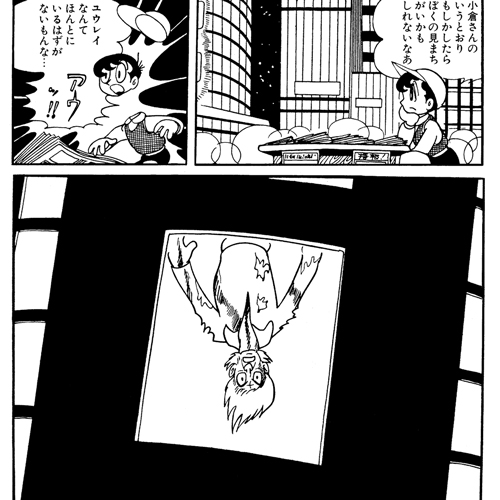
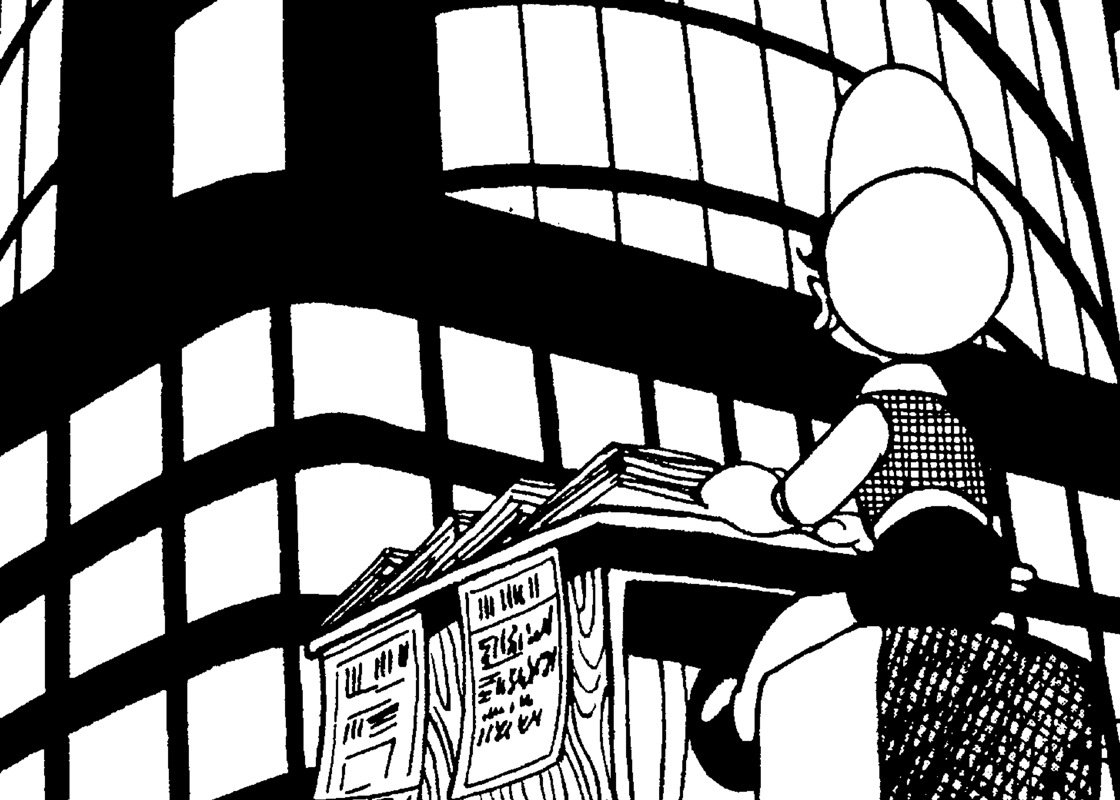
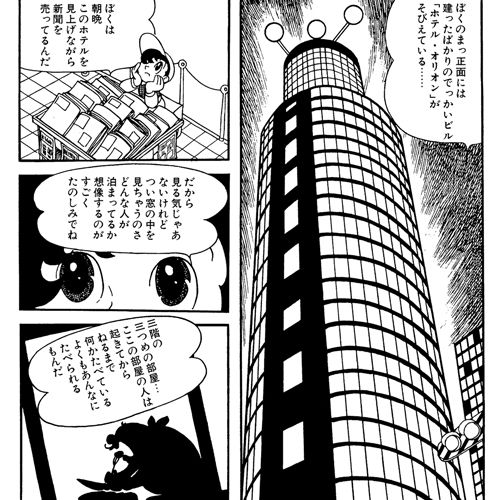
The incident unfolds at the Hotel Orion, a skyscraper standing right in front of Susumu’s newspaper stand. As the news that Dr. Brass, a world-renowned scientist, has gone missing during his stay in Japan spreads, Susumu notices a strange, ghost-like shadow in one of the hotel’s windows. He confides it to a young customer named Ogura. But, as expected, no one believes him.
However, that very night, Susumu witnesses something even more unsettling. In the window of the hotel, he sees the missing Dr. Brass hanging upside down as a gruesome corpse.
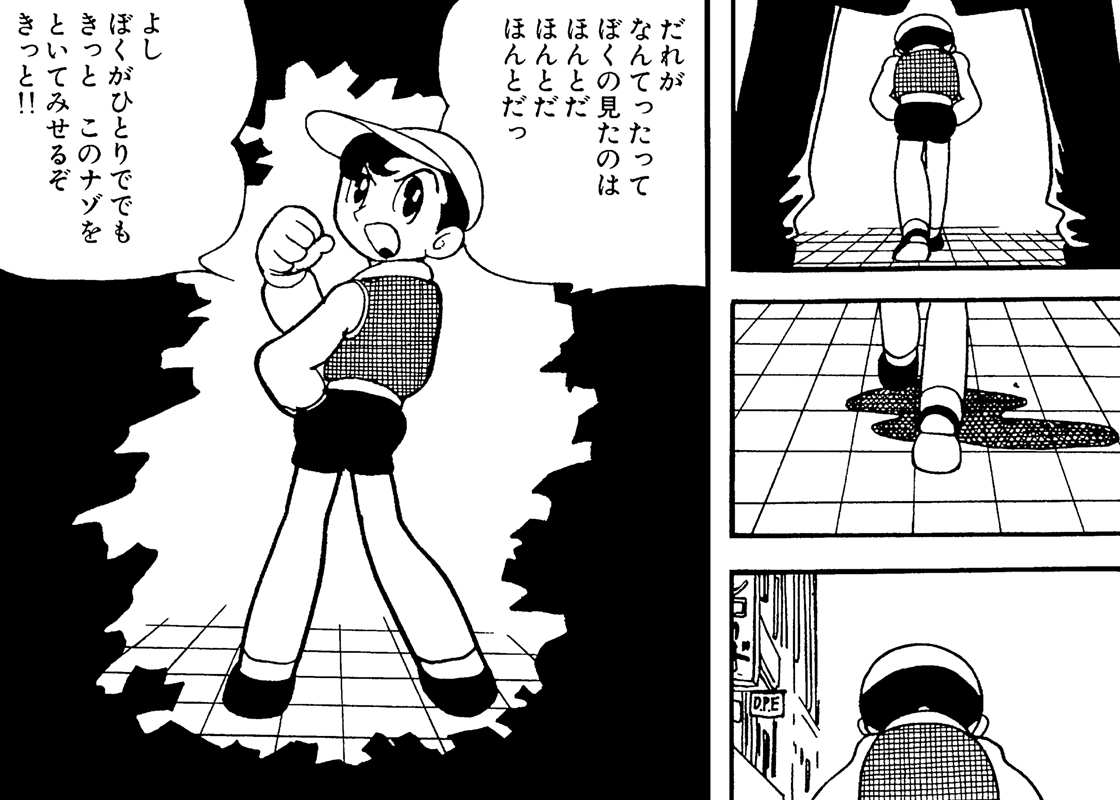
Determined to uncover the truth, Susumu takes on the role of a young detective and begins to investigate the mystery behind Dr. Brass’s disappearance.
DESCRIPTIONS
1963/03/03 Serialized in Shukan Shonen Sunday(Shogakukan)
When we read classic science fiction today, we sometimes feel a sense of dissonance arising from the gap between the imagined level of scientific advancement and our present-day reality. For example, in a futuristic world where highly advanced robots like Astro Boy are active, it can feel strangely out of place to see something as ordinary as a rotary telephone. Of course, some readers find a different kind of fantasy in this very mismatch—and even come to appreciate it as part of the work’s charm.
The work introduced here, The Eye in the Building, is categorized as science fiction, yet it largely avoids that kind of dissonance. Instead, it presents a mysterious incident that could plausibly have occurred in 1960s Japan, while still retaining a distinctly science-fictional flavor.
The main character, Susumu, is a boy who sells newspapers on the street. The image may evoke scenes from old black-and-white Hollywood films—a boy calling out “Extra! Extra!” as he hands out newspapers. Such figures are rarely seen today, but that is precisely the kind of job Susumu has. Although the story appears to be set in Tokyo, the city also carries a certain modern atmosphere reminiscent of Paris or New York.
The key attraction of this story lies in its use of a mysterious trick based on a scientific phenomenon, a hallmark of science fiction. Today, however, such a plot might be categorized less as SF and more as a detective story—something akin to Detective Conan. Within just sixteen pages, the narrative skillfully weaves together the incident, a twist, and its resolution, resulting in a compact yet satisfying work. Even when read as a mystery, it stands out as an elegant and cleverly constructed piece.